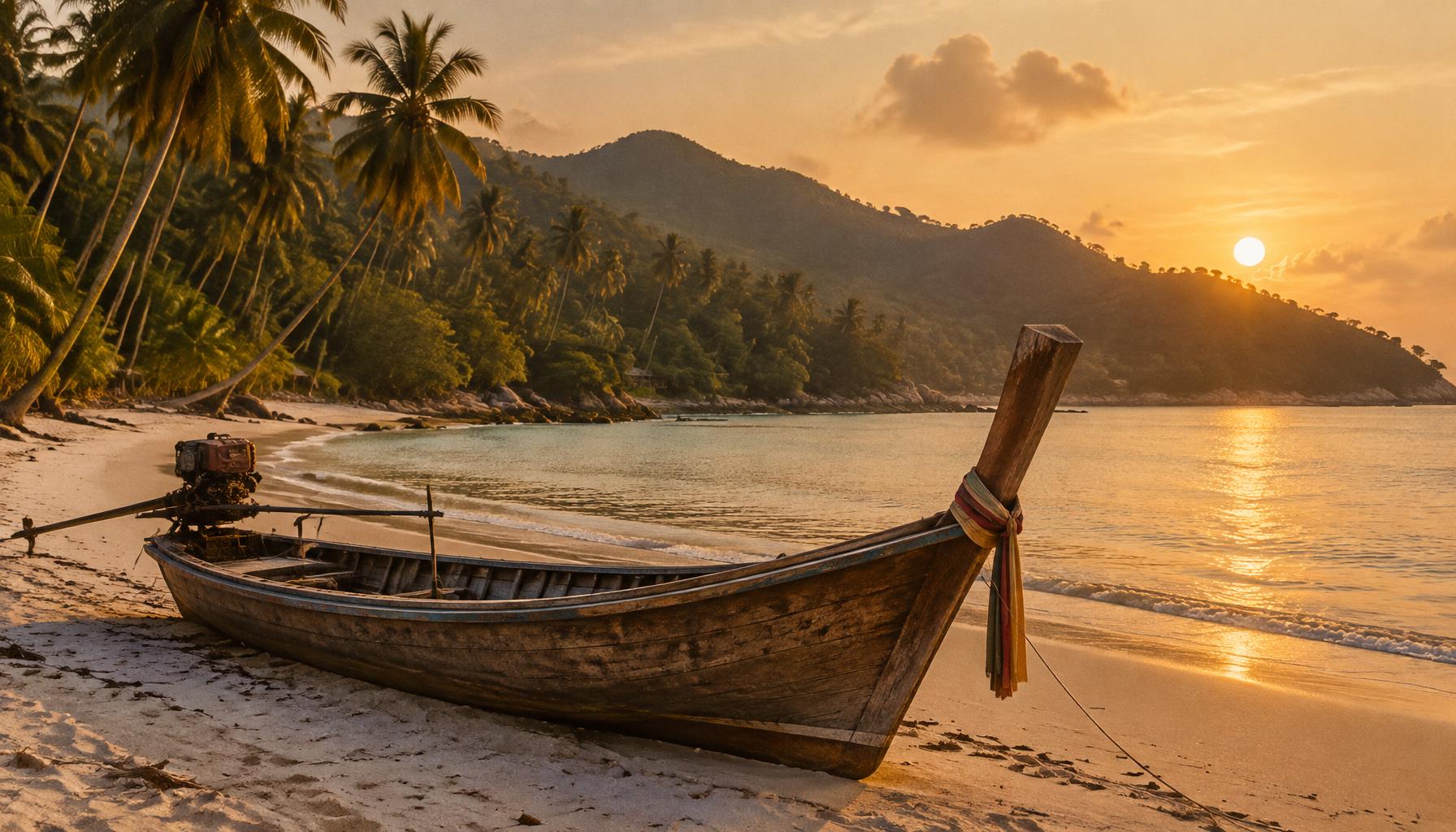
Most people arrive on Koh Phangan already knowing one thing about it. It's worth knowing what came before that, because the island's whole shape today - laid-back, a little off the grid even now, welcoming to whoever shows up looking for something different - was set long before anyone threw a party on Haad Rin.
Where the name comes from
Start with the name itself, because it's a clue to everything else. "Koh" is simply Thai for island. "Phangan" is thought to come from a southern Thai dialect word for sandbar - fitting, for an island ringed with them, from the walkable sandbar at Koh Ma to the shallow reefs off half its beaches. Long before it was known for a party, it was, literally, the sandbar island.
An island that grew coconuts, not a reputation
For most of its history, Koh Phangan wasn't known for much of anything outside the Gulf of Thailand. It came under Thai administrative rule in the late 1800s, and from then into the twentieth century it was, plainly, a coconut island - cleared coastal land planted with palms, the harvest exported by boat from small piers, fishing and a bit of rice and fruit farming filling in the rest. The population stayed small, likely a few hundred to a thousand people for much of that period, scattered across fishing hamlets rather than gathered in any one town.
There wasn't a reason for outsiders to come. There was no infrastructure to speak of - as recently as the 1970s, the island still had dirt roads instead of paved ones, no electricity grid, no telecommunications. A short-lived mining industry came through in the 1970s and petered out within a decade, and that was, for a while, the closest thing Koh Phangan had to an economy beyond coconuts and fish.
A monastery that got there decades early
One thing did quietly set the island apart long before backpackers arrived. Wat Khao Tham - the Mountain Cave Temple, built in 1894 above Baan Tai village near what's now Thong Sala - has run monthly Vipassana meditation retreats since 1988, founded by the Thai nun Mae Chee Ahmon specifically to teach international visitors. Decades before anyone had coined the phrase "wellness tourism," a hillside monastery on Koh Phangan was already doing it, in earnest, for travelers who'd found their way here. It's not a stretch to say the island's whole personal-development scene - which we'll get to in its own post - has real roots here, not just in the yoga studios that came later.
How the backpackers found it
Tourism proper arrived when it did for a lot of Southeast Asia's less obvious islands: through backpackers, in the late 1970s and into the 1980s, following the overland trail that had opened up in the wake of the Vietnam War. They weren't looking for infrastructure. An undeveloped island with cheap huts and a beach was the entire pitch, and Koh Phangan - cheaper and quieter than its already-developing neighbor Koh Samui - fit it well.
That first wave is also where the island's other reputation started. A small goodbye party thrown by a handful of travelers on Haad Rin beach grew, year over year, into what's now one of the most famous parties in the world - a story worth its own post, and one we've already told.
Thong Sala becomes the front door
Somewhere in the middle of all this, a fishing village on the island's southwest coast turned into its front door. Thong Sala was never much more than a pier and a market until tourism gave it a reason to grow - now it's the island's administrative center, its largest town, and still the point almost everyone passes through first, ferry ticket in hand, on the way to everywhere else. It's a useful piece of the island's history because it shows the pattern so plainly: a working fishing settlement that tourism grew, rather than replaced.
What grew alongside it
What's easy to miss, looking at the island from the outside, is that the party and the rest of Koh Phangan grew up more or less side by side, not as one thing overtaking the other. While Haad Rin built a reputation for itself, the rest of the coastline kept doing roughly what it had always done - fishing villages, coconut groves, a quieter pace - and slowly added the guesthouses, restaurants, and eventually the yoga studios and wellness retreats that now make up just as much of the island's identity as any full moon. Just offshore, the limestone islands of Ang Thong National Marine Park became one of the region's signature day trips, pulling the same curious travelers a little further out to sea before they came back to Phangan for the night.
By the time Koh Phangan had a name of its own, distinct from its more built-up neighbor Koh Samui, it had become something harder to sum up in one sentence: part backpacker legend, part fishing island, part meditation retreat, part something quieter that a different kind of traveler was starting to come here for on purpose.
That's the island the rest of this blog is really about - and it's a fair bit of why we built the villas here rather than somewhere with less history behind it. If you want the fuller, current picture of what's on the island today, our recommendations guide is the place to start.