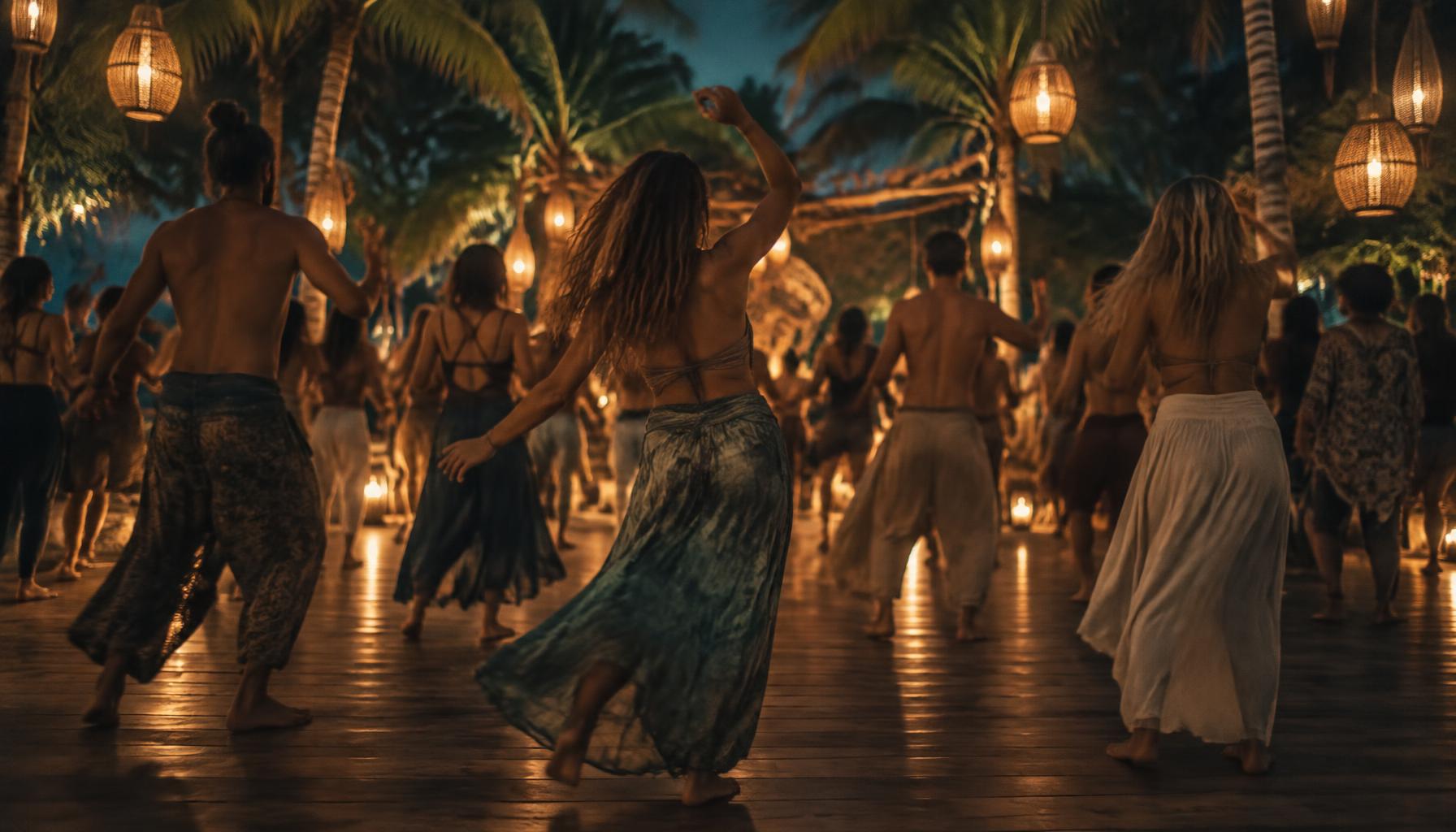
Walk past the right venue on a Friday night here and you'll see something that takes a second to place. A room full of people moving, barefoot, no partners, no steps that match each other, most of them with their eyes closed. Nobody's talking. It looks like nothing you'd call a party, and it isn't one - it's ecstatic dance, and it's one of the more quietly central things happening on Koh Phangan most weeks.
If you've never been, the name alone can be misleading. It sounds either like a rave or a therapy session, and it's closer to neither than you'd expect. There's no instructor telling you what to do, no choreography to learn, and no requirement to do anything in particular except move, or not move, in whatever way feels honest for the two hours you're in the room.
That looseness is the whole point, and it's also exactly why it's worth explaining before you show up for the first time.
Where it actually comes from
Ecstatic dance as a modern practice traces back to the late 1970s, when American dance teacher Gabrielle Roth developed 5Rhythms - a movement practice built around the idea that emotion and energy move through the body in identifiable waves, and that dancing them out, rather than talking them out, is its own kind of processing. Roth's five states - flowing, staccato, chaos, lyrical, stillness - still shape how a lot of ecstatic dance sessions are built, even ones that don't call themselves 5Rhythms directly.
The instinct behind it is much older than the 1970s, of course. Cultures have used unstructured, trance-inducing group movement for ceremony and release for about as long as there's been music to move to. What Roth did was take that instinct and build a secular, drop-in format around it that doesn't require any belief system, dance background, or prior session to understand - which is a large part of why it spread from California studios to a beach town in the Gulf of Thailand.
What actually happens in the room
A typical session runs a couple of hours, guided less by an instructor than by a DJ who builds the whole set as a single musical arc - usually starting slow and sparse, building through something more tribal or chaotic in the middle, and coming back down to something ambient and still by the end. You move with wherever the music is, not against it.
There are a few consistent rules, and they matter more than any dance step. No talking on the floor - it's a non-verbal space, and that's deliberate. No phones. No alcohol or drugs. No filming. You don't need a partner and nobody will pull you into a circle if you'd rather stay at the edge; sitting still and watching counts as participating too. Most venues ask you to arrive with clean bare feet and leave judgment, and your phone, at the door.
It's one of the only rooms on the island where nobody asks what you do for a living - only how you move tonight.
Don't be surprised if the range of what you see is wide - people crying, laughing, lying flat on the floor, moving like nobody's watching, because for those two hours nobody actually is. First-timers sometimes feel self-conscious for the first twenty minutes and then stop noticing themselves entirely somewhere in the middle. That's a fairly normal arc, not a sign you're doing it wrong.
Where to find it on Koh Phangan
The island has a steady rotation of ecstatic dance nights rather than one fixed venue - AUM Sound Healing Centre has run a long-standing Friday evening session, and other spots including Pyramid Yoga have hosted regular Sunday sessions, with occasional special nights and pop-ups elsewhere. Ticket prices are modest by most wellness-retreat standards, typically in the few-hundred-baht range, and some venues fold in a sauna or sound bath afterward as part of the same evening.
Schedules and venues shift fairly often here, so treat any specific night or price as a starting point rather than a fixed plan - a quick check of the island's current event listings (Phanganist and Phangan Life both track weekly wellness events) the same week you're going will save you a wasted trip.
Going for the first time
You don't need to prepare anything beyond comfortable clothes and an open mind. Eat lightly beforehand if you can - two hours of movement on a full stomach is its own lesson. Bring water. Go in with no goal beyond noticing what your body wants to do when nobody's watching and nothing is scheduled next.
It's one of the things that makes Koh Phangan's evening rhythm feel different from a lot of other islands nearby - the same week can hold a beach party and a silent dance floor a few kilometers apart, and plenty of people who live here do both. If it's the kind of evening that interests you, our recommendations guide covers the island's wider wellness scene alongside the beaches and food, whether or not you're staying with us.